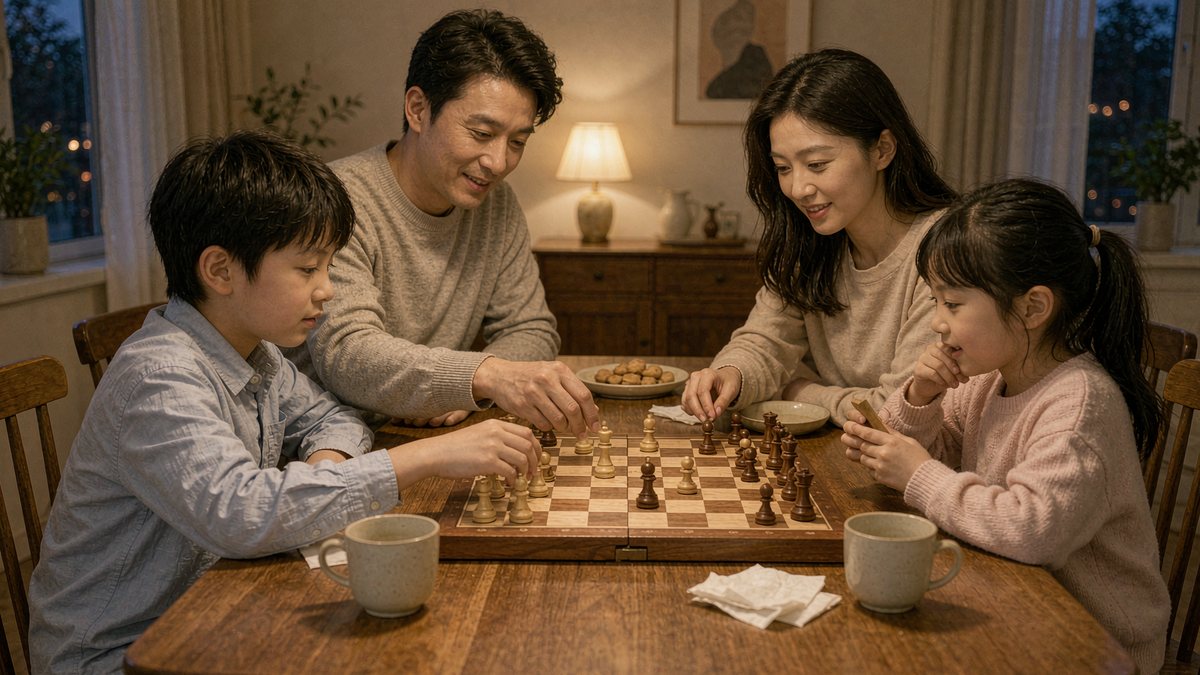
A good family game has a short setup, a clear rule set and a real chance for a child to win.
The short version
Best overall
Cooperative tile game
Best for four-year-olds
Colour-matching card game
Best for six and up
Dexterity stacking game
Best for a crowd
Party drawing game
How long we tested
Three months, fourteen games
9.1/ 10★★★★★Editor score
Our verdict
Buy games with short turns and simple scoring. A child who waits four minutes for a turn will lose interest before you finish explaining the rules.
Best forFamilies with children aged four and up
Budget$12-45
Family games live or die on turn length. An adult can wait ninety seconds without losing the thread; a five-year-old cannot. Everything else, including theme and production quality, is secondary.
We played fourteen games with children from four to nine, scoring them on how often they came back to the table voluntarily after the first evening.
How we chose
We weighted accessibility over depth, and cooperative games over competitive ones for the youngest players.
Rules explainable in under two minutes.
Turns that finish in under sixty seconds.
No reading required for the youngest player.
No elimination: nobody sits out for the second half.
What makes a family game work
Short turns, constant involvement
Games where every player acts on every turn, rather than waiting, hold a child’s attention far longer. Dice games and simultaneous-play games do this naturally.
A real chance to win
Children know when you let them win. Choose games with enough luck that a child can genuinely beat an adult, so nobody has to pretend.
Fast setup
If setup takes longer than two minutes, the game will not come out on a school night. Boards that unfold, cards that shuffle, done.
The bottom line
Start with a cooperative game for the youngest child and a dexterity game for the family. Cooperative games avoid the tears that knock competitive games out of rotation, and dexterity games let a six-year-old genuinely beat an adult.
Tested picks
What we would actually buy
01Best overall
Cooperative tile-laying game
$25-40
★★★★★9.3/10
Everyone works against the board rather than each other, which removes the losing-parent problem entirely.
What is the best first board game for a four-year-old?
A matching or colour game with no reading and very short turns. Save strategy games for six and up; at four the goal is learning to take turns without melting down.
Should I let my child win?
Sometimes, but choose games where luck does the work instead. A child who wins on a dice roll learns that winning is possible without being handed it.
How many family games do we need?
Three: one cooperative, one dexterity, one party game. That covers school nights, rainy Sundays and family gatherings.
GoKugo is reader-supported. We may earn a commission from links on this page. Read our disclosure.
The Sunday Shortlist
Six gift picks, one email a week.
No sponsored placements, no padded lists. Unsubscribe in one click.