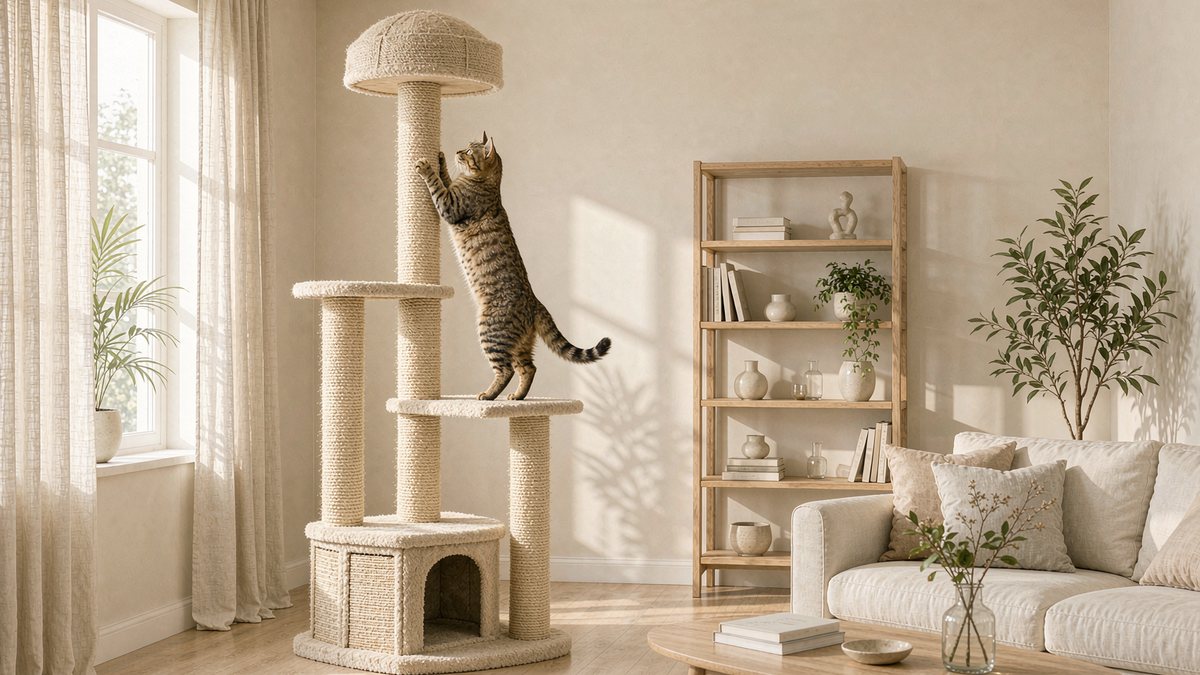
A cat tree is only as good as its base. Weight at the bottom decides everything.
The short version
Best overall
Floor-to-ceiling tension pole tree
Best for small flats
Wall-mounted shelf set
Best for seniors
Low stepped tree
How long we tested
Six months, eleven cats
8.7/ 10★★★★★Editor score
Our verdict
Buy height and a heavy base. A tall tree that wobbles is worse than a short one that does not.
Best forHouseholds with one or more indoor cats
Budget$70-260
A cat tree is furniture that cats climb, which means it has to satisfy two audiences. Humans want it to look acceptable in a living room; cats want height, stability and something to scratch. Most products compromise both.
We tested six trees over six months with eleven cats, including one that weighs seven kilos and tests every joint in a structure.
How we chose
Stability first. If a tree moves when a cat lands on the top platform, the cat will not go back up.
No movement at the top platform when a heavy cat jumps on.
Sisal on the surfaces cats actually scratch.
Platforms big enough to lie down on, not just sit.
Assembles in under an hour with the supplied tools.
What to look for
Base weight is the whole design
A wide, heavy base stops the wobble. Look at the base dimensions before anything else; most complaints about cat trees are really complaints about a small base.
Platform size
Cats lie down. A platform the size of a dinner plate is a perch; a platform the size of a cushion is a bed. Buy for lying down.
Sisal where it matters
Scratching happens on vertical posts at full stretch. Sisal on the post, carpet on the platforms.
The bottom line
Buy a floor-to-ceiling tension tree if you have the ceiling height and one steady wall, or a low, wide tree if you do not. Either way, check the base dimensions before the aesthetics.
Tested picks
What we would actually buy
01Best overall
Floor-to-ceiling tension tree
$120-220
★★★★★9.1/10
Uses the ceiling as an anchor, so it cannot wobble at the top. The most stable design we tested.